
Every April, millions of Canadians brace themselves for a familiar ritual, the annual scramble to file their taxes. Behind the numbers and receipts, however, lies a far more troubling reality. Our tax system—long overdue for an overhaul—has become an exercise in frustration, waste and needless anxiety. Yet each spring, we placate ourselves with short‑term deadline extensions rather than demand the radical modernization we deserve.
Two years ago, during the 2023 Canada Revenue Agency (CRA) strike, I launched a petition calling on Ottawa to push the filing deadline to June 15. By mid‑strike more than 30 000 Canadians had signed—proof not of a desire to avoid paying taxes, but of exhaustion with a system mired in complexity and breakdowns . They weren’t shirking their obligations; they were navigating a labyrinth of forms, opaque rules and digital roadblocks, all while CRA phone lines were offline .
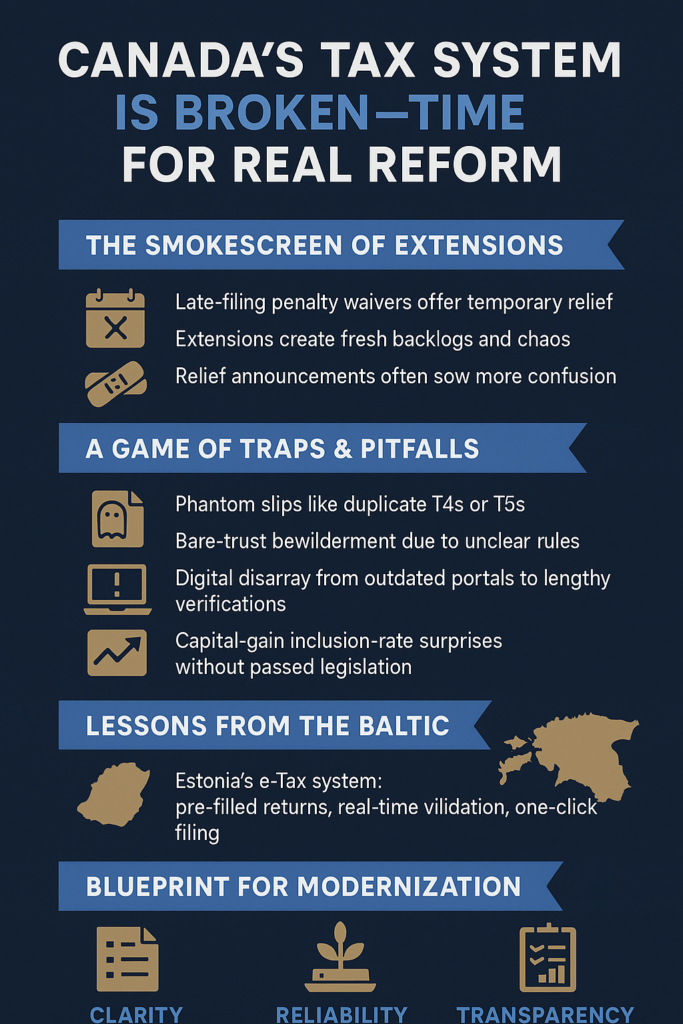
The Smokescreen of Extensions
This spring, the CRA again offered piecemeal relief: late‑filing penalty waivers for certain capital‑gains elections and information returns. But these gestures are little more than band‑aids over a hemorrhaging wound. They buy a few days for a subset of taxpayers, yet compound backlogs for CRA staff, thrust accountants into fresh last‑minute chaos and leave everyday Canadians wondering if they’ll be next in line for relief (canada.ca).
Furthermore, the CRA’s relief announcements often sow more confusion rather than clear the backlog. In its February 19 Tax‑Tip update, the agency pledged to “grant relief in respect of late‑filing penalties” for information returns filed by March 7, 2025, yet left the statutory deadline of February 28 unchanged, underscoring that only legislative amendment, not administrative grace, can actually move due dates Canada.ca. More recently, on April 30, 2025, the CRA confirmed that T1 filers reporting capital gains on T3 slips could file penalty‑free until June 2; it even signaled that spouses of those filers are eligible for the extension on accompanying forms and elections, including the T1135 foreign‑property report, although it has not publicly specified which forms qualify, leaving many uncertain whether their T1135 filings enjoy the same relief investmentexecutive.com. This is why the tax system is broken.
A Game of Traps and Pitfalls
As a CPA in Ottawa for the past decade, I’ve seen firsthand how tax season has morphed into a strategic video game, with hidden traps and penalty‑laden pitfalls at every turn:
- Phantom Slips: Duplicate T4s or T5s appear without explanation, forcing fliers to hunt down corrections with CRA agents.
- Bare‑Trust Bewilderment (“bare trust”: a simple trust arrangement where legal title and beneficial ownership are separated): New reporting rules are so poorly communicated that even CRA staff can’t say who must file or when.
- Digital Disarray: Outdated portals crash under minimal load, force repeated password resets and demand multi‑step identity checks that can take ten minutes or more.
- Capital‑Gain Inclusion‑Rate Surprises (the inclusion rate is the percentage of a capital gain that is taxable): Ottawa can announce a retroactive increase to the inclusion rate without passed legislation, blowing up taxpayers’ sale strategies at year‑end (canada.ca).
These hidden traps turn filing into a minefield—one that deadline extensions alone cannot defuse.
Lessons from the Baltic
Contrast this with Estonia’s e‑Tax system, where citizens file in under five minutes. Pre‑filled forms, real‑time data validation and one‑click signatures mean 99 percent of Estonian declarations go online quickly and seamlessly . No PDFs, no cryptic instructions, no phone queuing—just simple civic duty.
Promises vs. Progress
To its credit, the CRA has pledged “simpler systems,” “better infrastructure” and “ongoing consultation.” Yet each tax season feels like Groundhog Day: portal meltdowns, last‑minute relief announcements and overflowing community tax clinics.
A Blueprint for Modernization
Real reform rests on three pillars:
- Clarity: Eliminate redundant forms and overlapping rules. Every new regulation must include plain‑language guidance—for both taxpayers and CRA staff.
- Reliability: Invest in resilient, scalable digital platforms. Automate slip issuance via real‑time data sharing between agencies (e.g. EI, pensions).
- Transparency: Publish performance metrics—uptime, processing times, error rates—and hold the CRA publicly accountable.
From Burden to Civic Duty
Imagine a Canada where tax season means logging in, reviewing pre‑filled numbers and clicking “Submit.” Where families spend April evenings planning spring projects, not wrestling with login screens. Where small businesses focus on growth, not changing trust‑reporting rules.
The time for deadline extensions has passed. The Tax system is broken. Real leadership means asking not “Can we get a few more days?” but “When will our tax system match 21st‑century expectations?” Ottawa has the talent, the goodwill and the mandate to transform a broken relic into a model of modern governance. Canadians deserve nothing less.